This page shows examples of spatial analysis through terrain and view shed modeling. The first project summarizes research on the impact of sea level rise in a densely populated region, and the second demonstrates modeling a view shed to optimize solar energy capture.
Study of the Changes in Sea Level in San Luis Pass, Galveston Island, Texas
Problem Description
Sea level rise is a known challenge related to climate change that affects coastal communities globally. In the Gulf of Mexico, however, sea level rise is occurring at a measurably higher rate according to a study published in Nature Communications in 2023.
In the study of U.S. coastlines published by the United States Census Bureau in 2019, the Gulf Coast had a population of 18.8 million people, making up 4.9 percent of the total U.S. population (U.S. Census Bureau, 2019, para.2).
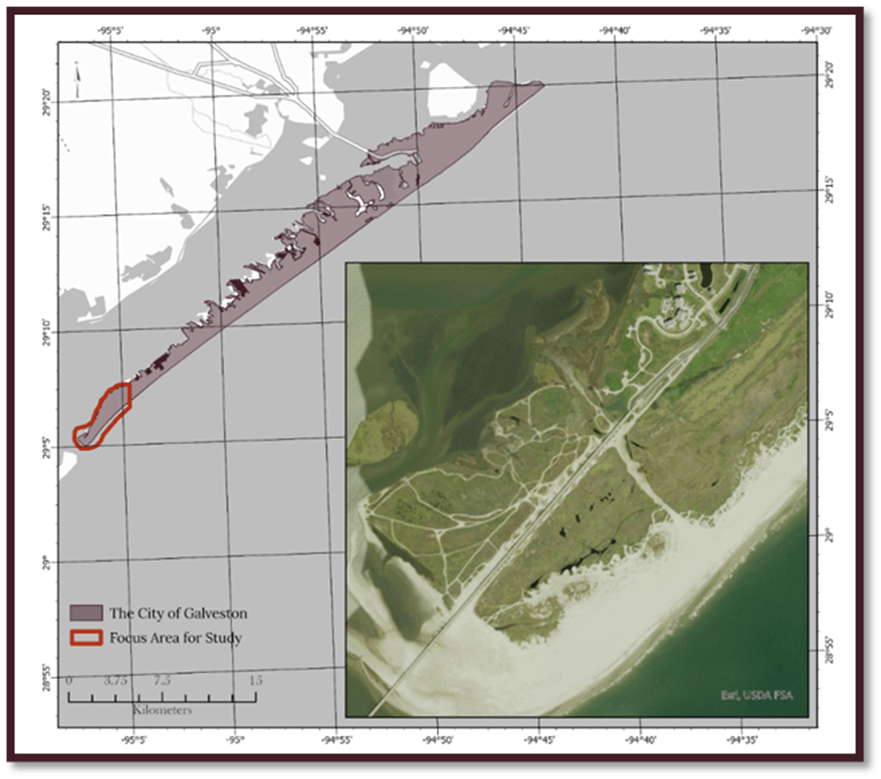
This study seeks to examine the risks of sea level rise on Galveston Island specifically, in the context of urban growth and development and population increase. The study area was selected to model shoreline changes and differences in elevation on a remote, unprotected portion of the island with the expectation that future work would apply the modeling processes to the entire island, including the urban areas.
Analysis Procedure
For this study the focus area was chosen because it is an unprotected, dynamic part of the shoreline where changes can be easily measured. Regular erosional patterns characteristic of barrier islands can be observed here, and this portion of the island is less densely populated than the east end.
I began by researching available data sources and identifying what would be useful to this study. During that process of discovery, I downloaded over 300 LAS and TIF files in various resolutions and quality levels. I created an ArcGIS Pro project with a map for each data type — lidar, digital elevation models, imagery, culture data and analysis.
I created a data catalog in Excel where I captured the name of each file I downloaded, its file type and the link to where it originated so I could capture proper citation and metadata and I created a project log to document my workflows.
Once the data was identified, I then began processing it so it would be suitable for the study.
To calculate the shoreline, I looked up the mean high-water datum for my study area on the NOAA Tides & Currents site.
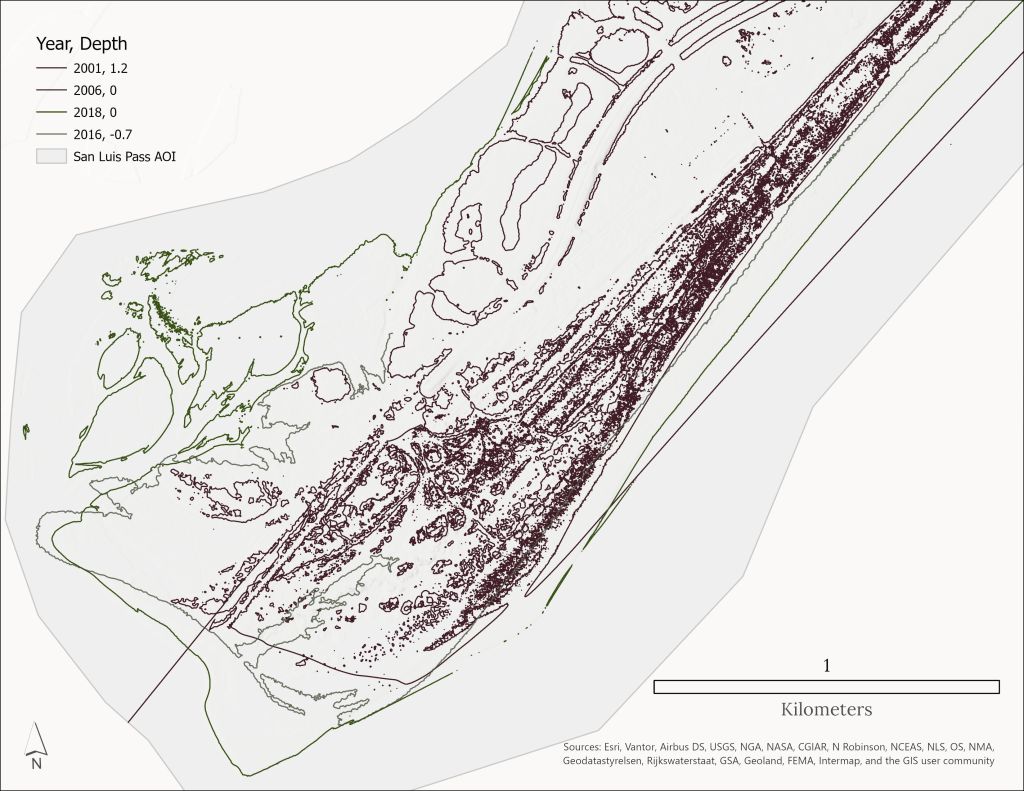
Using this data, I calculated a shoreline for each of my digital elevation models using the Contour geoprocessing tool and setting the z-value to .4 meters.
Once the elevation models and shoreline vectors were calculated, I used map algebra to compare the data sets and understand the changes. In ArcGIS Pro, I used the Raster Calculator geoprocessing tool to do this.
Results
As expected, my study found that the area of interest lost elevation during the time frame studied. In the images below, the model shows a loss of elevation in the far western end of the study area of 2.7 meters.
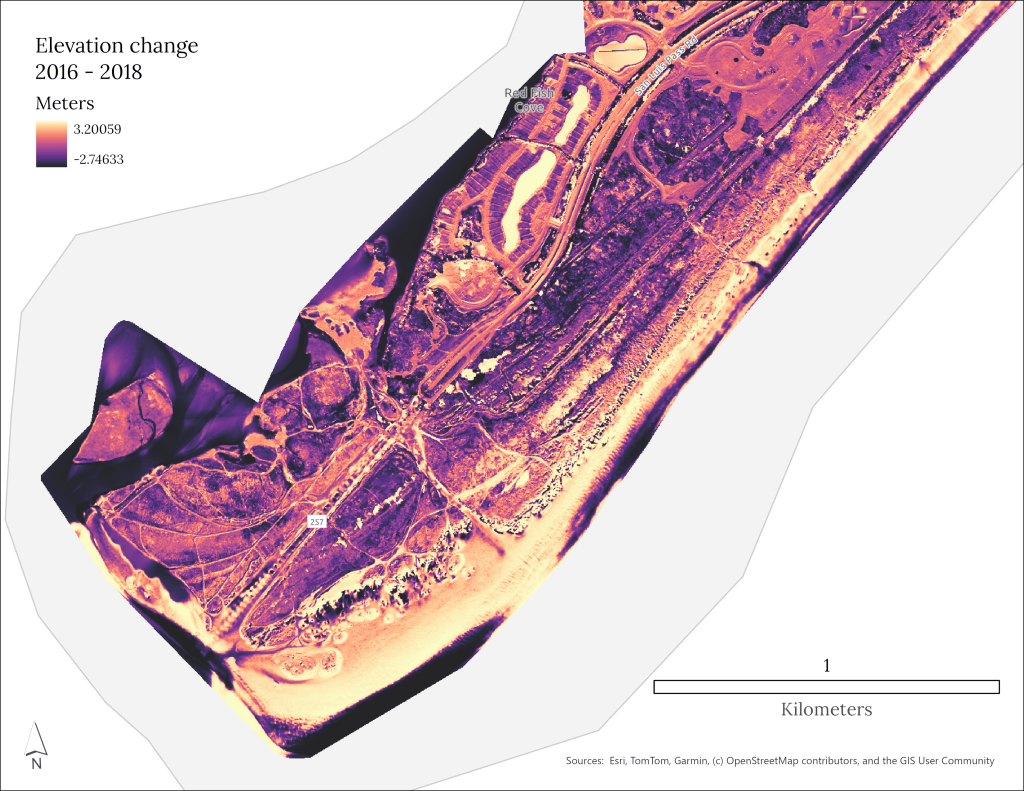
I used available lidar data to model the elevation changes of the study area over a period of several years. I extracted the shorelines from these digital models and compared them. This process illustrates the change over time, and future work will apply these workflows to the entire island.
Reflection
For this project I was able to develop a new ability to use lidar data to create effective digital elevation models, then use that as a basis to extract vector data for illustration and analysis. I found this work particularly engaging and believe that I gained an important new skill set as well as a deeper understanding of the physical environment.
I used my experience acquiring and cataloging large volumes of data to efficiently research available data options and focus on the most suitable sources for my research. Using that data for this kind of analysis was a new capability for me.
Understanding and working with large datasets is one thing, but being able to actively convert that data into useful information was exciting, as was creating digital models of the physical environment.
Viewshed & Solar Energy Potential Analysis
Problem Description
Understand and evaluate line of sight and viewshed principles and applications including evaluating the dynamics and components of solar radiation on terrain by measuring cast shadows and describing solar energy potential.
Analysis Procedures
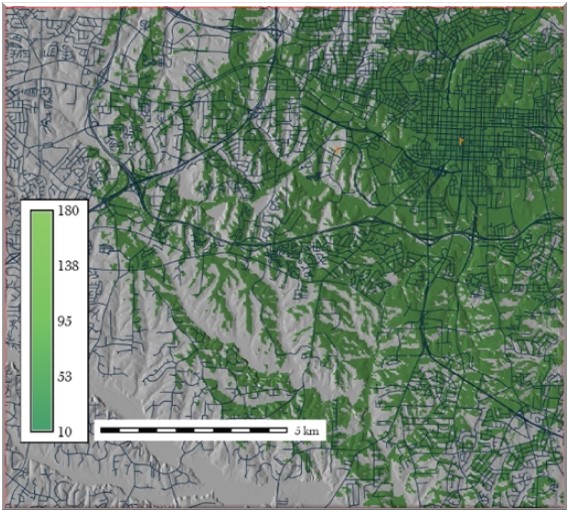
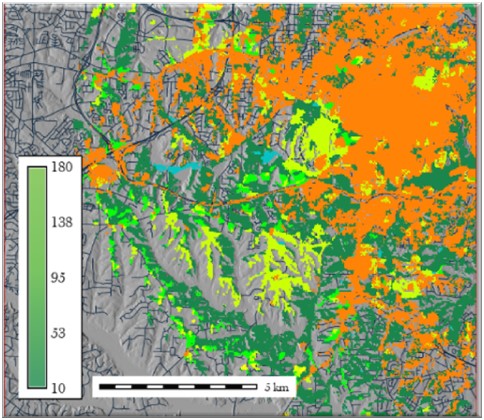
Begin by performing a basic viewshed analysis, computing the viewshed from a 32-story tower in a given location. The image below shows the viewshed against a shaded relief background. The second image shows the land use for the view area.
To measure solar radiation over a given area, and measure its energy potential, we modeled the slope aspects of the terrain and building we wanted to analyze, then computed the sun’s position on December 22nd and 2:25 PM EST and used that to calculate incidence angles and cast shadows at that time.
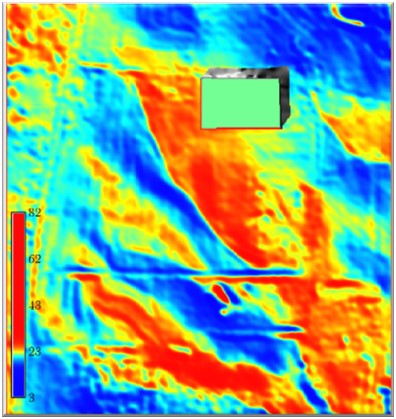
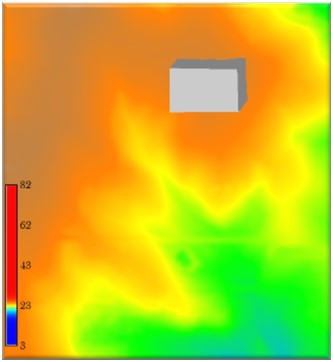
We then extracted the cast shadow area for 14.4 hours and computed an incidence angle map to show the angle between the topography and solar ray. To identify changes during the day of the winter solstice, we compare reports from the two data sets in figures below.
Results
The outcome of these procedures was a visualization of the change in solar energy access on a structure, which is useful when planning to install solar panels or harness solar energy in other ways. Evaluating the availability of solar energy during the year is important because the available watts and the intensity available in locations where solar rays will be collected must be considered.
Reflection
During this project and other similar exercises studying geospatial modeling I gained new skills and understanding of the methods used to measure and model the physical world. Performing a viewshed analysis wasn’t something I had done before, and I learned a lot about the complexity and importance of this type of modeling.
I gained proficiency in using GRASS GIS, something I was unfamiliar with prior to this experience. Modeling the terrain using both ArcGIS Pro and GRASS GIS gave me useful insights into the strengths of each platform, enabling me to better determine which might be suited to a particular project.
 Sarah's Spatial Portfolio